Executive summary
Legitimate healthcare calls are often labeled "Spam Likely," blocked or screened before the patient's phone rings, and the caller is not told. Hiya reports that 86% of unidentified calls now go unanswered. STIR/SHAKEN proves a number is not spoofed but says nothing about who is calling. Getting Through argues that deliverability is an ongoing discipline: reputation monitoring, branded caller ID, full attestation and screener-aware calling.
Key findings
- 86%
- of unidentified calls now go unansweredSource: Hiya, State of the Call 2026
- 82%
- of Americans admit ignoring calls they actually wanted, up from 59% two years earlierSource: Consumer survey data cited in Getting Through (Consig, 2026)
- 34%
- of Americans report missing important calls because caller ID wrongly flagged them as spamSource: Consumer survey data cited in Getting Through (Consig, 2026)
- 17%
- of confirmed spoofed calls carried the highest "A"-level STIR/SHAKEN attestationSource: Transaction Network Services (TNS), mid-2026 report
- 10–12%
- of call traffic that passed STIR/SHAKEN verification was still tagged as unwantedSource: Transaction Network Services (TNS), mid-2026 report
Why do compliant healthcare calls go unanswered?
The paper opens with a scenario that most outreach teams will recognize. A hospital calls a patient two days after discharge. The patient gave consent and a clinician signed off on the call. It arrives on her phone as "Spam Likely," her phone sends it straight to voicemail, and she never calls back. The hospital's dashboard shows that the outreach program ran. The patient's experience is that nobody called.
Most of the attention in patient outreach goes to what happens during the call: the script, the AI, the handoff, the consent record. All of it depends on an earlier step that now fails often, which is the call being delivered, trusted and answered. Industry data suggests that roughly half of outbound calls are never answered, and only about a quarter of dials reach a live person. Hiya's State of the Call 2026 found that 86% of unidentified calls go unanswered, and 82% of Americans say they have ignored calls they actually wanted, up from 59% two years earlier.
Who decides whether a call rings?
Between every outbound call and every handset sits a layer of labeling and blocking infrastructure that decides, before the phone rings, whether it rings at all. Carriers and their analytics partners score calls in real time on traffic patterns, complaint data and number reputation. Calls that score badly are labeled "Spam Likely," "Scam Likely" or "Telemarketer," or blocked outright. The TRACED Act explicitly empowered providers to block at the network level, with safe-harbor protection when they do. The paper maps five layers a call passes through, and the caller owns none of them:
- Attestation, controlled by the originating carrier.
- Labeling and blocking, controlled by terminating carriers' analytics engines.
- Name and brand display, controlled by carrier branding programs and the CNAM ecosystem.
- Device screening, controlled by Apple, Google and third-party apps. AI screeners on most US handsets now question callers before a human hears anything.
- The patient's own judgment, the final decision to answer.
Why are legitimate callers hit twice?
For an organization doing legitimate calling, the labeling layer produces a double loss. False positives block real calls regularly: 34% of Americans report having missed important calls because caller ID incorrectly flagged them as spam. And the caller is not reliably told which calls were blocked, or why.
Ordinary healthcare calling also looks like spam to an analytics engine: high volume from a single number, short call durations because most attempts reach voicemail, repeated attempts to numbers that never answer, and bursts of activity when a recall campaign runs. A program can degrade its own number reputation simply by running as designed. The paper contrasts this with email, where deliverability has been a recognized discipline for twenty years. Most healthcare organizations can say how many calls they dialed, but not how those calls displayed on a patient's screen, on which carriers, this week. In healthcare the cost is clinical: a blocked post-discharge call can mean an unfilled prescription or an unreported symptom, and a blocked reminder can become a no-show.
Does STIR/SHAKEN solve the problem?
No. STIR/SHAKEN, the caller-authentication framework the FCC has required of major voice providers since 2021, cryptographically attests that a call's originating number was not spoofed in transit, at full, partial or gateway level. That is valuable, but it is the whole of the claim. Authentication is not identity. The framework says nothing about who owns the number, why they are calling, or whether the recipient should trust them, and the patient cannot see the signature anyway.
The telemetry now reflects this. Transaction Network Services, which analyzes traffic for more than 150 carriers and also sells voice security and branded calling, found in mid-2026 that 17% of confirmed spoofed calls carried "A"-level attestation, and that 10–12% of traffic that passed verification was still tagged as unwanted. In the FCC Wireline Competition Bureau's December 2025 triennial report, USTelecom said some providers assign "A"-level attestation to invalid or Do Not Originate calls, and ZipDX called attestation "effectively meaningless." The Bureau still found the technology effective at authenticating caller ID and declined to replace it. Coverage is also uneven: the seven largest US carriers have plateaued at roughly 85% signed traffic between networks, smaller carriers sit near 20%, and signatures are stripped wherever a call crosses a legacy TDM or SS7 segment.
What does a serious deliverability practice involve?
The paper treats STIR/SHAKEN as table stakes, not a strategy, and sets out the components of a deliverability practice that sits alongside it. Two features stand out. Reputation is perishable: carrier algorithms retrain and labels drift, so a number that is clean today can be flagged next month. And almost none of this work is visible in a product demo. Two outbound systems can sound identical and still differ by double digits in real-world answer rates.
- Number registration and reputation management: register numbers with carrier analytics providers, monitor display across carriers, detect a spam label within hours, and rotate or retire burned numbers.
- Branded caller ID: show the verified organization name, and increasingly a logo and call reason, across each carrier's branding program. 78% of consumers say a verified business logo would make them more likely to answer.
- Full attestation: structure carrier relationships so calls sign at full rather than partial or gateway attestation, a prerequisite for branding programs.
- Screener-aware calling, pacing and spoofing surveillance: detect answering machines and AI screeners, spread attempts to stay within what analytics engines tolerate, and watch for your own numbers being spoofed.
Where is regulation heading?
Toward verified identity. In October 2025 the FCC adopted a Further Notice of Proposed Rulemaking proposing that voice providers display verified caller identity (name, logo, call reason) using Rich Call Data, the identity extension to STIR/SHAKEN. In April 2026 it proposed enhanced Know-Your-Customer rules for originating providers, followed in May by a Know-Your-Upstream-Provider proposal, and a separate proceeding addresses number churning. The Commission has proposed tying that diligence to attestation decisions, which concedes that a signature alone is not evidence of identity. The details are still contested, but the paper's reading is that verified identity is moving from competitive advantage toward regulatory expectation. For more, see STIR/SHAKEN Proved Your Number Is Real. It Didn't Get You Answered.
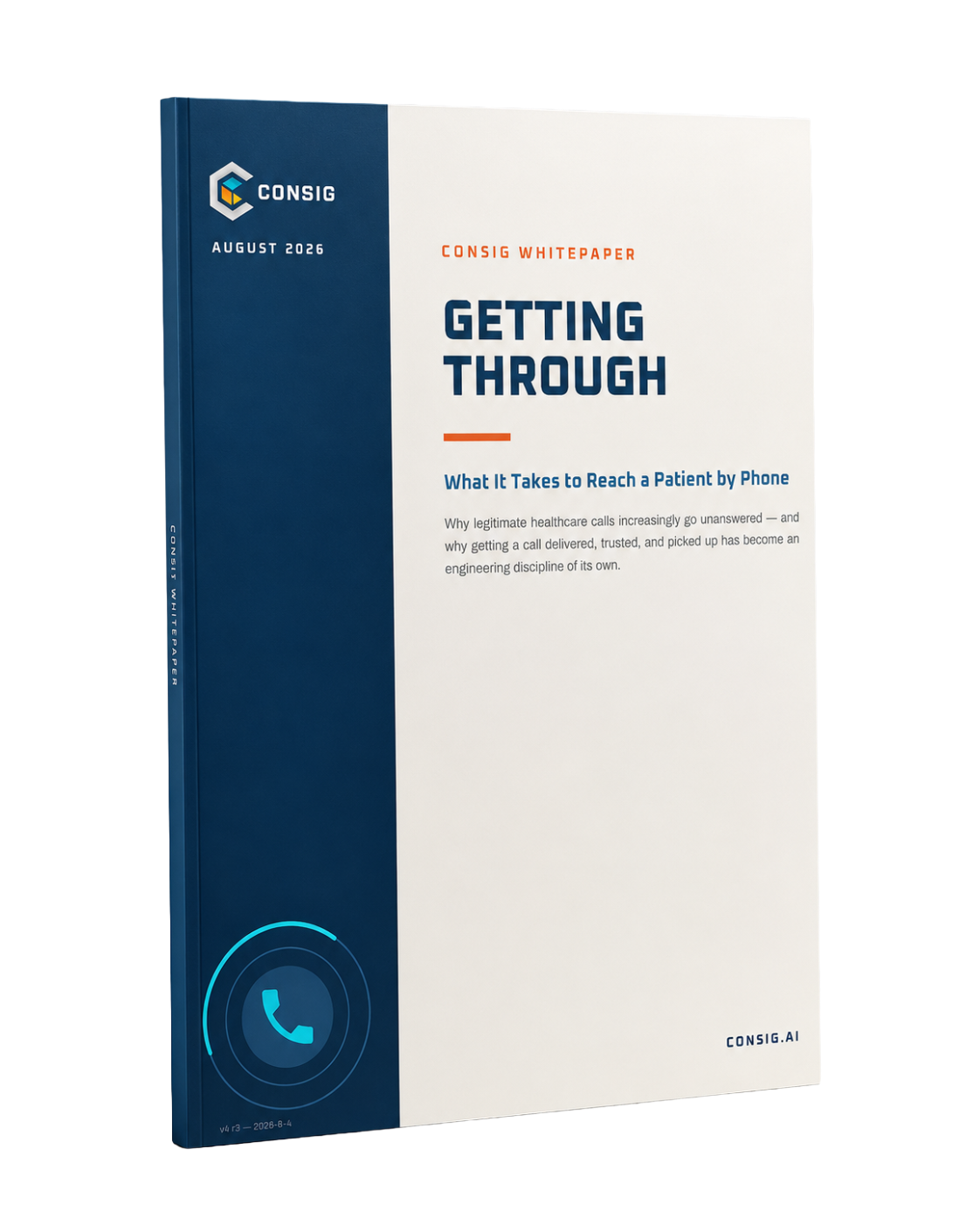
Read the full paper. What it takes to reach a patient by phone when the call never rings.
Frequently asked questions
Why do hospital calls show up as "Spam Likely"?
Carrier analytics engines score every call in real time on traffic patterns, complaint data and number reputation. Normal healthcare calling, with high volume from one number, short voicemail-length calls, repeated attempts and campaign bursts, looks like spam to those models. So a program can damage its own number reputation simply by running as designed, and the caller is not reliably told which calls were labeled or blocked.
Does STIR/SHAKEN stop healthcare calls from being labeled as spam?
No. STIR/SHAKEN attests that the displayed number was not spoofed in transit. It does not identify who is calling or why. TNS data from mid-2026 found that 17% of confirmed spoofed calls carried top "A"-level attestation, and 10–12% of verified traffic was still tagged as unwanted. Getting Through treats attestation as a baseline, not a deliverability strategy.
What is branded caller ID, and does it help calls get answered?
Branded caller ID shows the calling organization's verified name, and increasingly its logo and call reason, on the recipient's screen through each carrier's branding program. 78% of consumers say a verified business logo would make them more likely to pick up. The FCC proposed in October 2025 to require display of verified caller identity using Rich Call Data.
How often should a calling program check its number reputation?
Continuously. Carrier algorithms retrain and labels drift, so a number that is clean today can be flagged next month without notice. The paper describes reputation management as a monitoring loop rather than a setup task: monitor how every number displays across carriers, detect a "Spam Likely" label within hours rather than weeks, and rotate or retire numbers that have been burned.
Sources
- Hiya, State of the Call 2026
- Transaction Network Services (TNS), mid-2026 robocall and call-authentication report
- FCC Wireline Competition Bureau, triennial report on STIR/SHAKEN (December 2025), including comments from USTelecom and ZipDX
- FCC Further Notice of Proposed Rulemaking on call branding and Rich Call Data (October 2025)
- FCC proposed Know-Your-Customer rules for originating providers (April 2026) and Know-Your-Upstream-Provider proposal (May 2026)
- TRACED Act