
In a recent post, we showed how a single follow-up call can dramatically cut hospital readmissions. (See A Phone Call Cut 30-Day Readmissions From 17% to 3.5%.) Very encouraging news! But if you're running a campaign like that, pay close attention to managing patient consent. The goalposts are shifting.
For years, patient consent worked like a box on a form. You captured it once, filed it, and treated the question as settled. That model is gone, and the teams still running on it don't always realize it.
Before we get into the details, we'd like to point out that using Consig to manage your patient outreach campaigns is the easiest way to shift this burden off your shoulders. This is exactly the kind of detail our system hides under the covers.
Two recent changes at the FCC are at the root:
- A consumer can now revoke consent through any reasonable means — spoken in the middle of a call, sent by text, typed in an email — and the business has to honor it within 10 business days, down from the previous 30. The patient no longer has to use your preferred channel or your magic keyword. If a person makes their wishes clear, the clock starts. This went into effect April 11, 2025.
- A broader "revoke-all" rule is coming. That means: if a person opts out of one message type, it revokes consent for everything from that person. This has been delayed to January 31, 2027 while the FCC reconsiders it under its deregulatory "Delete, Delete, Delete" initiative. During the waiver, opting out of one healthcare message type stops only that type.
Consent is revocable
The delay is only a temporary reprieve. A rule that might be strengthened, softened, or scrapped inside a year is harder to operationalize than a strict rule that simply holds still. With a fixed rule, you build to it once. With a rule in motion, you have to run today's version correctly and stay ready to pivot whichever way it lands.
That reframes what consent actually is. It is no longer a fact you record. It is a state — one that can flip at any moment, arrive through any channel, and has to propagate across every active campaign almost immediately.
To make this concrete: A patient who replies "stop" to a text from the hospital pharmacy cannot get an automated call the next week from a different department. This would block even a high-value call like, say, a post-discharge follow-up (again, see our recent post A Phone Call Cut 30-Day Readmissions From 17% to 3.5%).
Keeping track of it all
We mapped this territory in our compliance whitepaper, One Call, Three Rulebooks — the full picture of how telecom, healthcare, and AI rules meet on every patient call. Since we finished it, the ground has shifted again — this time from the courts. In February 2026, the Fifth Circuit held in Bradford v. Sovereign Pest Control that the TCPA's text does not actually require written consent for marketing calls. That undercuts an FCC rule businesses had built against for over a decade. A Maryland district court joined that view a month later.
So while the FCC tightens the rules for revoking consent, courts are dismantling the rules for capturing it. Consent law is now moving in both directions at once. That is the strongest evidence yet that the real burden is not any single rule — it is the churn.
What that requires in practice
Treating consent as a live state, rather than a filed fact, means an outreach program has to:
- Keep a consent system of record that every campaign reads from, so there is one source of truth per patient and message type.
- Recognize a mid-call opt-out the moment it is spoken — not only a reply to a designated keyword.
- Propagate a revocation across all channels within days, well inside the 10-business-day window, so no campaign is working from stale permission.
- Track the rules themselves. The requirements above are current as of this writing — and two of them are under active reconsideration. A consent system that cannot absorb rule changes will be out of date before it is fully deployed.
One development worth watching on the record-keeping side: vCons, an IETF-track standard that packages a conversation — participants, transcript, and governance metadata, including consent — into a single portable, tamper-evident object. Companion drafts are underway for recording the lawful basis of a conversation, so a program can prove after the fact that consent existed at call time. For where this is heading, see The Pulver vCon Report, the running chronicle from vCon Foundation founder Jeff Pulver.
The takeaway
The good news is that none of this argues against automated outreach — patients still want these calls and texts, and staff still need the time back. It argues for building the consent machinery correctly: one record, updated the instant anything changes, enforced on every call and message before it goes out.
Our compliance whitepaper, One Call, Three Rulebooks, covers the full consent-and-revocation picture, including where the revoke-all rule is likely to land.
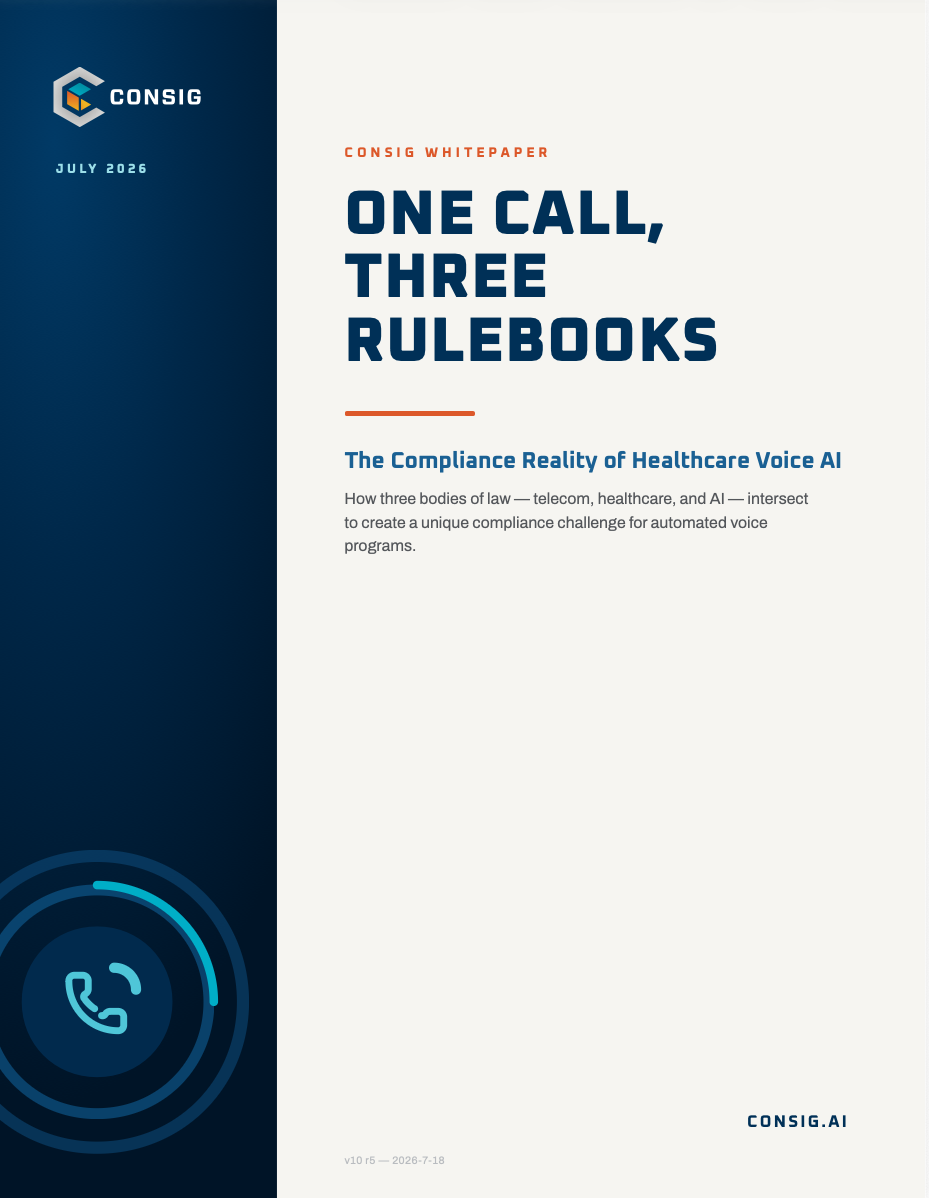
Whitepaper
One Call, Three Rulebooks.