
In the first half of 2025, plaintiffs filed 1,052 TCPA class actions — against 539 in the same stretch of 2024. That is a 95% increase over a year that was already the worst on record. September alone set a single-month record of 224 filings, close to four times the prior September. What does that mean for legitimate uses of outbound calls, particularly in healthcare?
First, let's be clear: this is not a blip, and it is not going to slow down. More than three-quarters of TCPA suits are now filed as class actions — the format built for maximum leverage. The plaintiffs' bar has noticed how well the statute pays: a leading defense attorney has called the TCPA "the biggest cash cow in history" for that side, and expects filings to climb another 50% this year.
The settlements tell you the stakes
These are not nuisance amounts.
Recent enforcement, by the numbers
- ~$145M — combined FTC judgment against Assurance IQ and MediaAlpha over an alleged "consent farm."
- ~$29.5M — Citibank settlement of robocall allegations.
- ~$30M and ~$20M — pending settlements against Momentum Solar and Coldwell Banker.
- $10.5M — Kaiser Permanente, TCPA/FTSA class settlement over texts sent after recipients replied "stop" (Fried v. Kaiser, Dec 2025).
- $1.86M — OptumRx, robocall settlement over clinical-adherence calls placed to wrong numbers (Patterson v. OptumRx, Mar 2026).
For years, the standard reassurance was that these were someone else's lawsuits — telemarketers, lead generators, solar installers. The last two entries end that comfort. Kaiser Permanente and OptumRx are healthcare, and the OptumRx case should be read twice: the calls at issue were medication-adherence calls — clinically motivated, well-intentioned outreach that reached the wrong numbers. That is not a rogue marketing operation. That is the exact fact pattern of a patient-outreach program with a consent and data-hygiene gap. The legal theories underneath every case on this list — consent, revocation, autodialer definitions, disclosure — are the ones an AI-powered patient-calling program has to navigate on every call. The plaintiffs found the pressure points in adjacent industries first. Now they have found healthcare.
Adding an AI voice makes it worse, not better
There is a comfortable assumption that automation reduces legal exposure. For outbound calling, the opposite is true. Since the FCC's February 2024 ruling, the law treats an AI-generated voice as an "artificial or prerecorded" voice — the robocall category. So a synthetic voice does not lighten the TCPA burden. It plants you squarely inside that burden, with the same consent and disclosure obligations that generate these lawsuits, now applied to a system placing calls at machine scale.
When the people who price risk get nervous
If the filing counts feel abstract, look at who is backing away from the risk. Insurers are treating TCPA exposure as something they would rather not cover. Munich Re, one of the largest reinsurers in the world, put it plainly in a 2025 client advisory:
"These changes significantly raise the bar for compliance — and the risk of violations. A single unsolicited message to 10,000 recipients could result in 10,000 violations, each carrying statutory penalties."
Munich Re Specialty – North America, July 2025
The advisory goes on to note that many standard policies exclude TCPA claims outright, and that only a limited market will cover the exposure at all. When the firms whose entire business is pricing risk hesitate to touch one, that hesitation is information. The risk is real, and it is priced.
Where this leaves an AI outreach program
The uncomfortable part is that most of these violations are not failures of intent. They are failures of execution — a consent status that didn't propagate, a disclosure that didn't fire, a number that kept dialing after an opt-out. At a few calls a day, a human catches those. At scale, only the system does. Which means the safest place for the rulebook is inside the calling infrastructure itself, enforced on every call, rather than in a binder someone reviews once a quarter.
Our compliance whitepaper, One Call, Three Rulebooks, walks through where the exposure actually sits in an AI patient-calling program — and how to keep it from landing on you.
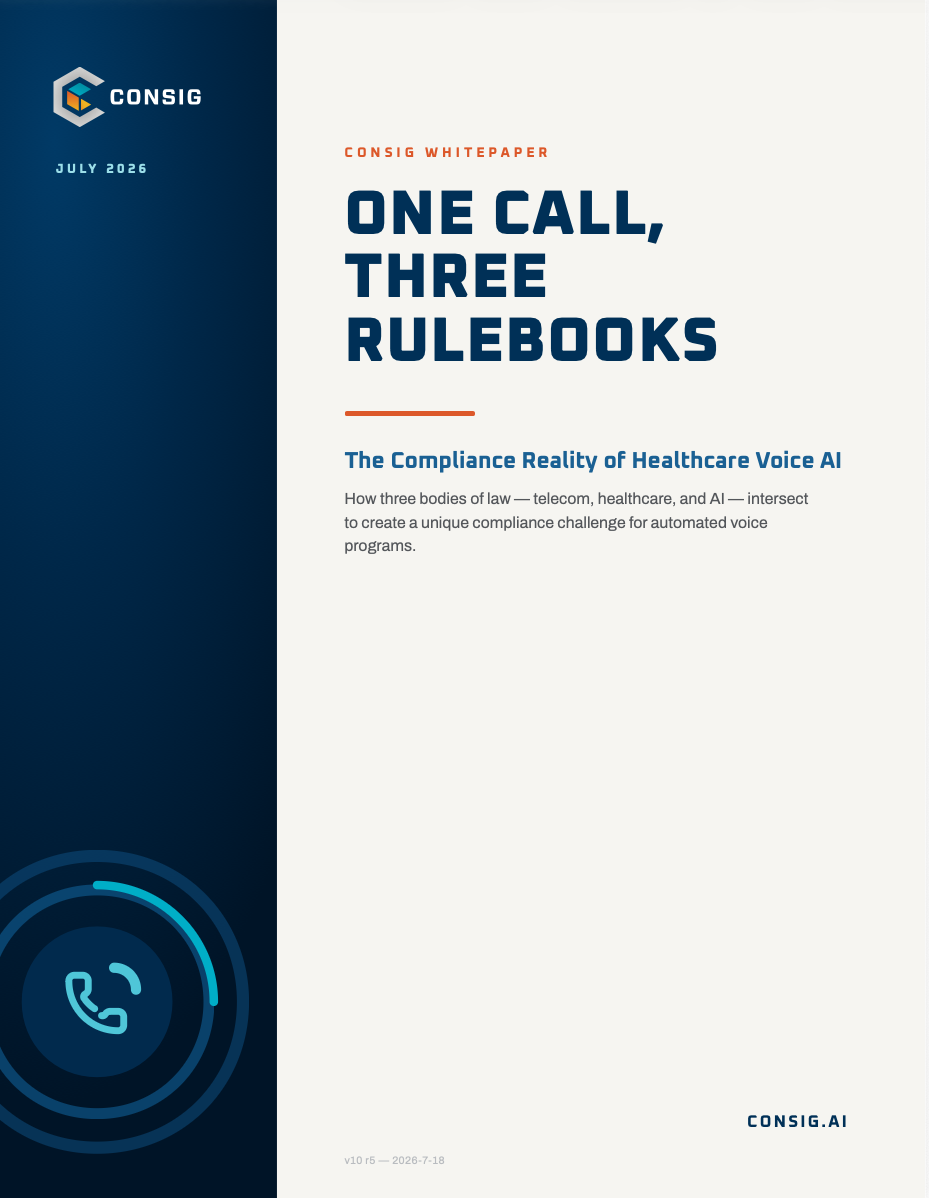
Whitepaper
One Call, Three Rulebooks.