
Here is the tension that sits inside every AI-powered patient call, and it does not resolve on its own.
What makes voice AI worth deploying is open-ended conversation. The model hears a free-form answer, interprets it, and decides what to say next. That is a genuine breakthrough, and it is probabilistic by design — the same input can produce a different, perfectly reasonable output.
What makes a patient call lawful is the opposite. A disclosure has to be delivered in the required words. Identity has to be verified before a single detail of protected health information is spoken. An opt-out has to be recognized and honored the moment it leaves the patient's mouth. That behavior is deterministic by definition. It has to happen the same way, every time.
Both of these live in the same sixty-second call.
Why "almost always" is the wrong target
The instinct is to tune the model until it gets the compliant steps right nearly all the time. But "nearly all the time" is a trap. A system that behaves correctly 99% of the time still mishandles a legally binding step thousands of times across a large calling program, and each miss can carry statutory damages measured per call. You cannot prompt your way to certainty, because certainty is not what a generative model is built to give you.
Part of what makes this hard is that the market misunderstands its own technology. Forrester's 2024 AI Pulse survey found that roughly 70% of U.S. generative-AI decision-makers believed a generative model always returns the same output for the same prompt. It does not. Opus Research, writing the same year, called that non-determinism "a double-edged sword, enabling creativity while also posing risks of inaccuracy." The creativity is the product. The inaccuracy is the liability. They come from the same place.
The teams who have actually shipped voice AI into regulated healthcare settings already work around this. The pattern that holds is to let the model generate "only within clearly defined boundaries aligned with organizationally approved content." Deterministic handling of the risky steps is not a limitation on the technology. It is the correct use of it.
The analysts scoring the market now say the same thing, in stronger terms. Forrester's Q2 2026 Conversational AI Wave screened roughly 650 vendors down to 14, and its qualifying language is the tell: a platform "must pass muster with risk-averse legal and compliance teams" with enforceable guardrails. Not hopeful ones.
The resolution is a map, not a choice
The mistake is to frame this as natural versus compliant, as if you had to sacrifice one for the other. You don't. The real work is knowing, for each moment of the call, which regime that moment belongs to.
Timeline of one patient call: four short scripted steps carry the legal weight, and the generated conversation between them fills most of the call.
Must be spoken in the required words, on every call
Right patient confirmed before any health information
Minimum necessary — and in some states, kept off the model path entirely
Honored the moment it is said, and propagated
Some steps carry legal or clinical weight: the AI-voice disclosure, consent capture, identity verification, the minimum-necessary limit on what health information gets discussed. Those need scripted, deterministic handling that behaves identically on call number one and call number one million. The steps in between — acknowledging a frustrated patient, finding an appointment time that actually works — benefit from natural conversation, and should stay natural. The whitepaper's phrase for this discipline is matching the conversational technology to the task — chosen deliberately, step by step.
The dilemma runs deeper than words, too. In some states, protected health information and biometric identifiers may not be permitted to touch the general-purpose AI path at all. So the map is not only "scripted here, generative there." It is also "this data never reaches the model."
And the hardest part is that the map moves. Which step needs a disclosure, which state reclassifies a voiceprint as biometric data, which message type just lost its exemption — all of that shifts as the law does. Drawing the map once is not enough. It has to be redrawn as the rules change underneath it.
This is the part that's actually hard
The open secret of voice AI in healthcare is that generating a natural-sounding conversation is largely a solved problem. The hard part is everything underneath it: the telephony, the consent orchestration, the disclosure logic, the data handling, and the jurisdictional reasoning that decides which regime each moment belongs to. None of that is glamorous, and all of it is where the exposure lives.
That is not a reason to sit out the opportunity — the upside for patients, and for the staff worn down by phone tag, is too large. And the risk runs both ways: there is a cost to deploying this badly, and a cost to not deploying it at all while the phones go unanswered. Either way the answer is the same. Build the determinism in deliberately, step by step, rather than hope a probabilistic system happens to behave.
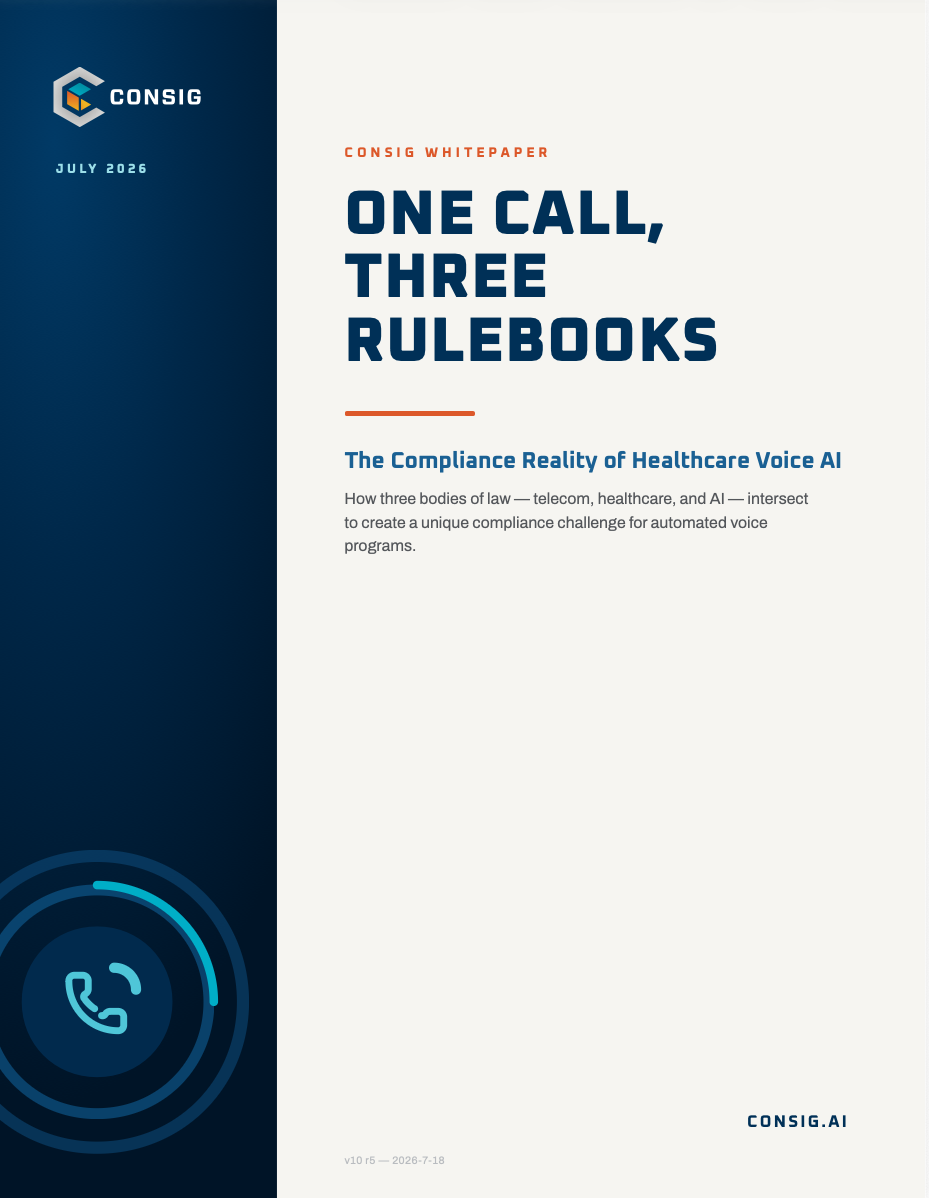
Our compliance whitepaper, One Call, Three Rulebooks, lays out exactly which steps carry the legal weight — state by state, message type by message type.
Whitepaper
One Call, Three Rulebooks.