
Large language models have changed what an automated call can be. A system can now ask an open-ended question ("How have you been feeling since the procedure?"), interpret a free-form answer, and decide what to do next. That capability arrived at exactly the moment the staffing arithmetic made pure nurse-led calling unsustainable.
Which raises the question every health system evaluating this technology should ask first: where, exactly, is the line? What should the automation do, and what should it never touch?
The call is a sensor
Before drawing the line, it helps to be clear about what the call is for. A follow-up call is a sensor, not just a service. Hospitals have no near-real-time signal for which patients left without understanding their medications or their follow-up plan. A structured call is the earliest available detector of a recovery going off track: the prescription never filled, the red-flag symptom, the visit that was never scheduled, the missing caregiver at home.
A sensor has to run on every patient to be useful, which is precisely what manual programs cannot deliver, and automation can.
The division of labor
The right split is specific. The automation handles the mechanics of connection and structured intake: it dials, verifies identity, walks the structured protocol, collects the patient's answers, and documents the call. It does not assess the patient, interpret symptoms, or give medical advice. When an answer matches an escalation rule, the call goes to a person: live within seconds for an urgent red flag, or into the care team's own follow-up queue, with the call's full context attached, for everything else.
Clinical judgment stays with clinicians. What the automation removes is the dialing, the voicemail, the retries, and the documentation. Work that was consuming nursing capacity without using nursing skill.
Two design principles that make it safe
First: match the conversational technology to the step. A single call mixes steps of very different risk. Identity verification, consent capture, red-flag screening, and clinical-instruction read-back have to happen the same way on every call, so they run as deterministic, scripted flows. The parts that benefit from sounding natural (acknowledging a frustrated patient, finding a convenient callback time) can use generative AI. A well-built system chooses between the two deliberately, step by step, rather than letting a probabilistic model improvise a legally or clinically binding moment.
Timeline of one patient call: disclosure, ID check, PHI limit and opt-out run as scripted steps between stretches of generated conversation.
Must be spoken in the required words, on every call
Right patient confirmed before any health information
Minimum necessary — and in some states, kept off the model path entirely
Honored the moment it is said, and propagated
Second: every escalation needs an owner. A flagged finding that reaches no one is worse than no program at all. Who responds, how quickly, and what happens after hours should all be decided before the first call is placed, and each handoff should carry the call's audio and structured intake with it.
What this buys
Done this way, automation changes the staffing equation without changing the standard of care. The same clinical team covers a far larger discharge cohort. Nurses spend their time on the patients whose answers actually need clinical judgment, instead of on dialing and voicemail. And every outreach attempt is documented as a matter of course, closing a record-keeping gap that EHRs have never handled well.
Our whitepaper, The Follow-Up Gap, lays out the full division of labor, the escalation design, and the evidence behind the follow-up call, including the compliance rules that make the deterministic steps mandatory, not optional.
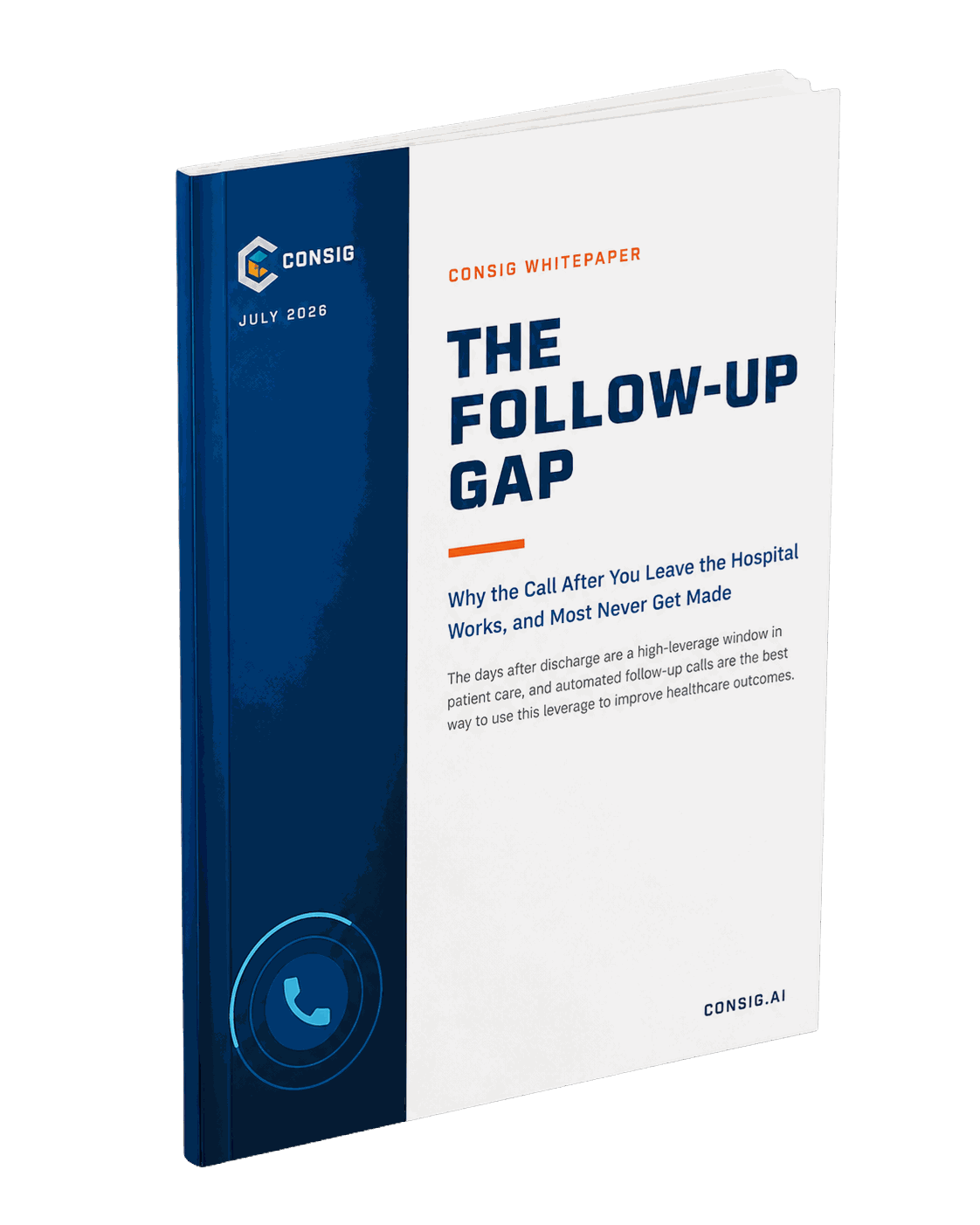
Whitepaper
The Follow-Up Gap.